
In this paper, we obtain convergence of a posteriori error indicator to 0 when the mesh size h goes to 0 for the finite element approximation of source-boundary control problems governed by a system of semi-linear elliptic equations. We give the upper and lower bound of a posteriori error, and convergency of a posteriori error indicator.
| Published in | Mathematics Letters (Volume 11, Issue 2) |
| DOI | 10.11648/j.ml.20251102.12 |
| Page(s) | 41-59 |
| Creative Commons |
This is an Open Access article, distributed under the terms of the Creative Commons Attribution 4.0 International License (http://creativecommons.org/licenses/by/4.0/), which permits unrestricted use, distribution and reproduction in any medium or format, provided the original work is properly cited. |
| Copyright |
Copyright © The Author(s), 2025. Published by Science Publishing Group |
Semi-linear Elliptic Equations, Source Control, A Posteriori Error Estimate
 is denoted as the form of sum with respect to elements of an indicator
  , i.e., as the form of infinite series when h goes to 0 unlike spectral method.
 denote the
  norm and inner product. We set
 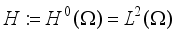 ,
,  with
with  .We denote by
  or
or 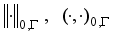 the
the  norm and inner product, and by
 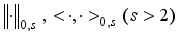 the
the  -norm and duality product between
  and
and 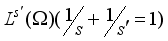 .
.  be a bounded convex polygonal domain in
  with boundary
  .
. 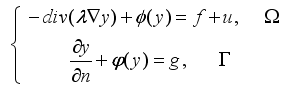 (1)
(1) 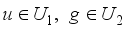 are to be controlled and the feasible sets are convex closed subsets of
 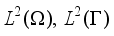 as follows.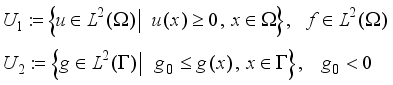
 .
.  and they are strictly monotonic in

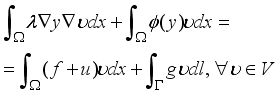 (2)
(2)  is given,
 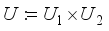 .
. 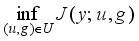
 is a solution of (2).
  is a solution of Problem 1. There exists
  that satisfies:
  (3)
(3)  in the
  in the direction of
 satisfy the following equations, respectively.
  (4)
(4)  in the direction of
 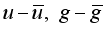 are as follows:

 of the following adjoint system.
 .
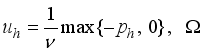
.  in the second equation of (4) and
  in the adjoint system, and comparing them, we get
  .
. 
 into regular triangles
 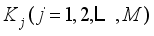 and denote the diameter of a triangle
  by
by  , respectively. We set
 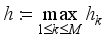 , let
, let  be the family of triangles,
  the set of all the sides of the triangles and denote finite element function space of
  as:
as: 
 denotes a polynomial space whose order is less or equal than one on element
  .
.  (5)
(5) 
 is the unique solution of(5).
  , which satisfies the following system (optimality system)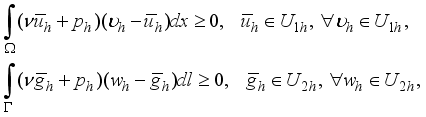
 (6)
(6)  (7)
(7)  is the unique solution of (7).
  :
: 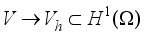 denote an orthogonal projection operator. For
  , we have: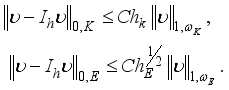




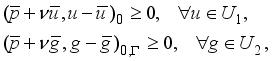
 is the solution of problem 1, then
  .
. 
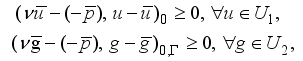
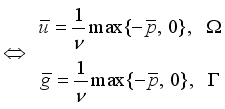
 and
and 
 by assumption 1,
  from the smoothness of the solution of an elliptic equation and
  has a unique solution in.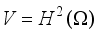
 , the continuity of
 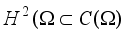 and
and 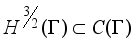 and the properties of operator
  , the assertion of the theorem holds.
  is coercive with respect to
  ,
,  are bounded independent of
  . In the below equation satisfied by
 when considering the asumption 1, we get


 are norm equivalent constants of spaces
 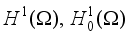 and
and  is a constant independent of
  .
. 
 ,
,  .
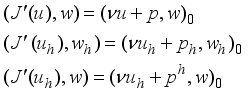
. 
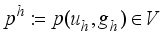 satisfies the following system
  (8)
(8) 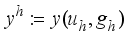 is a unique solution of the first expression of (5).
  (9)
(9) 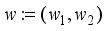 is an arbitrary element in the neighborhood of
  .
. 
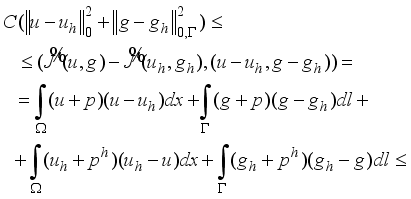
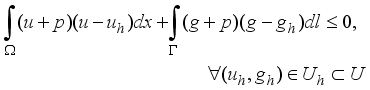
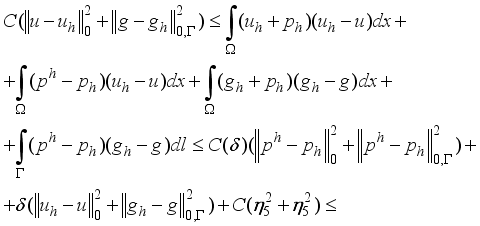


 .
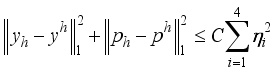
. 
 are as follows.
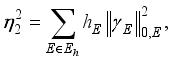
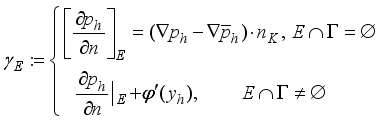
 is the jump value of the directional derivative in the common boundary
  of two elements
  .
. 
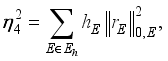
 is the jump value of the directional derivative in the common boundary
  of two elements
  .
. 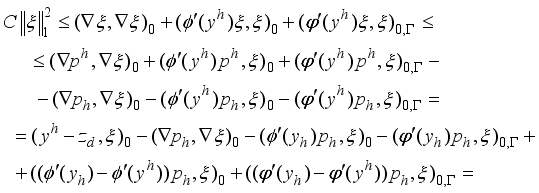
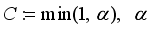 are positive, seen in theorem 1.
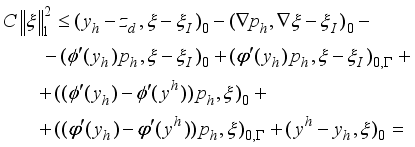
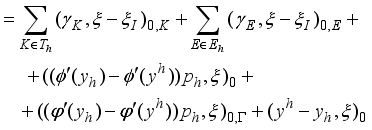
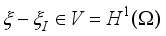 and 1) of lemma 2, we get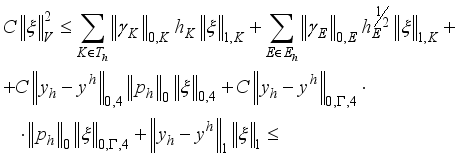
 .
. 
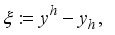
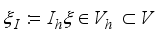 ,
,  .
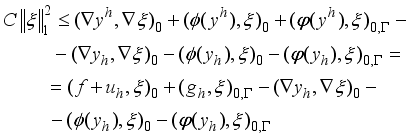
. 
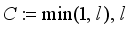 is a strictly monotonic constant of in assumption 1.


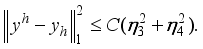
 are the solutions of (3) and (6), (7) respectively, then the following relation holds.
 (10)
(10)  (11)
(11)  (12)
(12)  , setting a test function as
  and using the strong monotonicity of
  and the monotonicity of
  , we get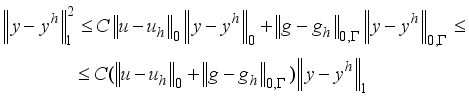
 .(13)
.(13)  , setting a test function as
  and considering assumption 1, we get
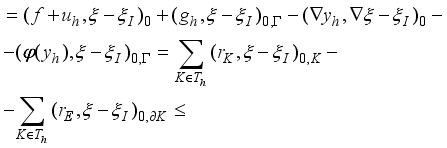
  (14)
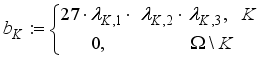
(14) 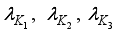 of element
  .
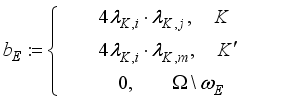
. 
 is a common edge of elements
  .
. 
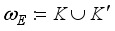
 and edge
  ,
,  have the following properties.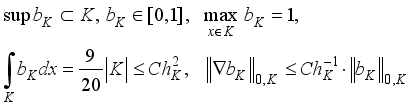


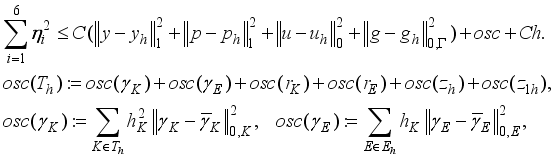
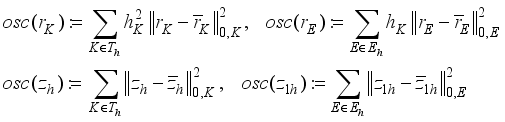
 .
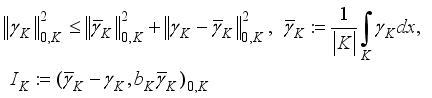
. 
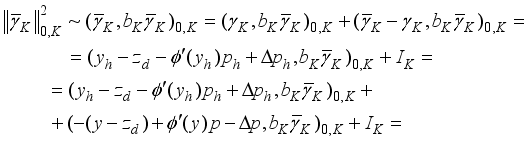


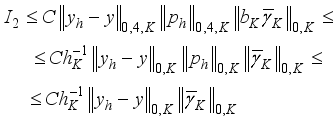




 .
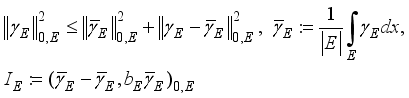
. 




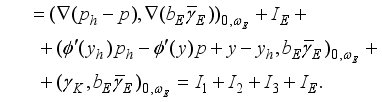



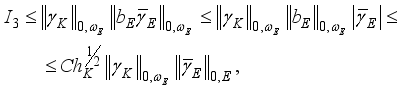

 .
. 






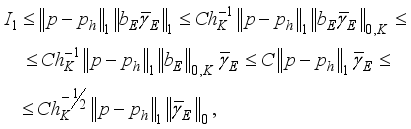
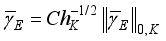 .
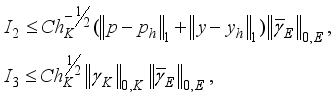
. 
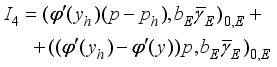
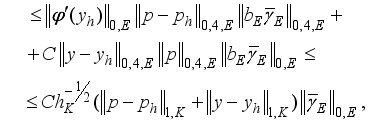

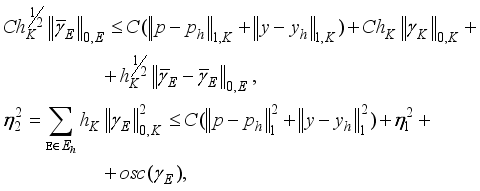
 .
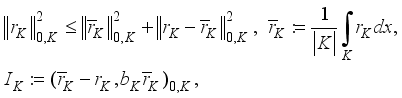
. 



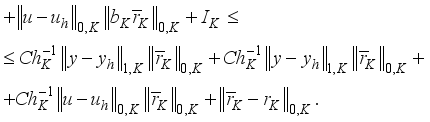
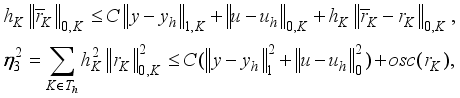
 .
. 
 .
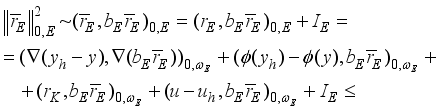
. 

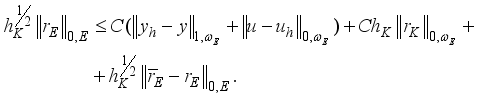

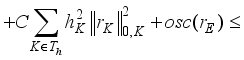



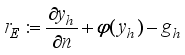 .
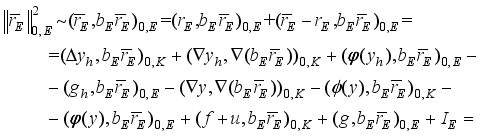
. 
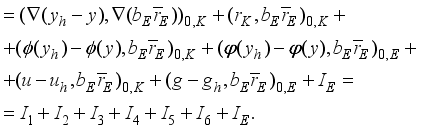

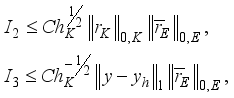

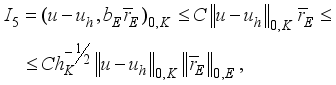

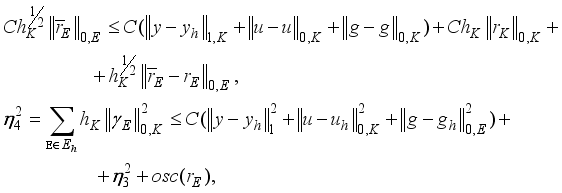
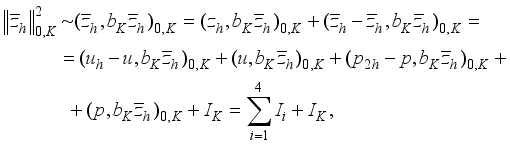
 . For convenience, we accept the following notation
  .
. 
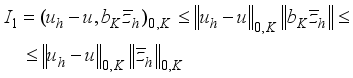
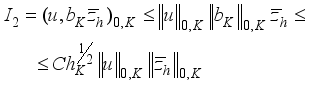
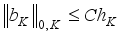 .
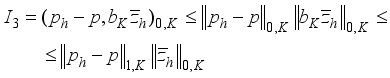
. 
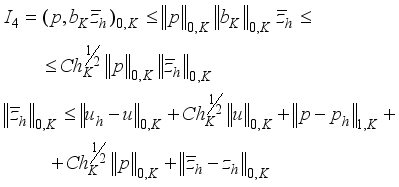
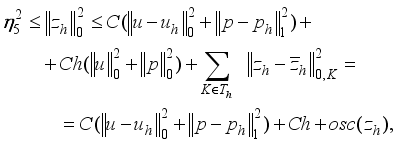
 .
. 

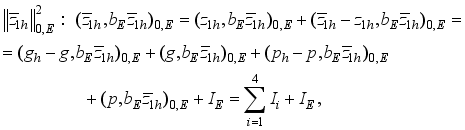




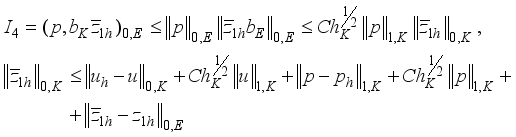
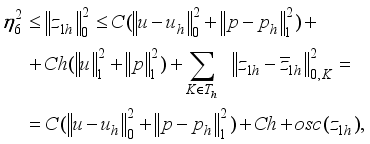
 , we get the result of the theorem.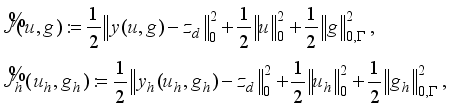
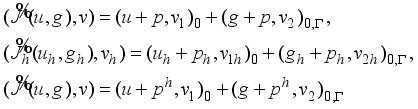
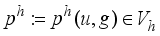 is the solution of the following equation.


 is a constant independent of
  .
.  (15)
(15)  (16)
(16)  as
as  and fix
  .
. 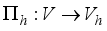 be a standard interpolation operator.
  and we define
 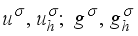 as
as  (17)
(17)  .
. 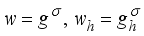 add together and put in order, then we get
 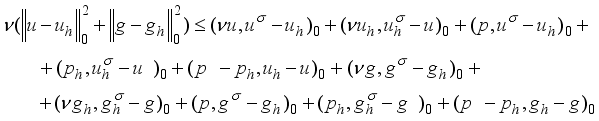 (18)
(18) 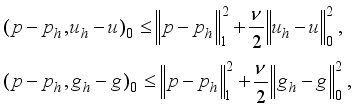 (19)
(19) 
 and considering the boundedness (lemma 2) of finite element solutions independent of
  , we get the estimation.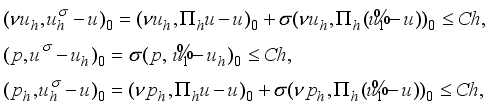
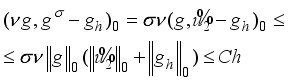

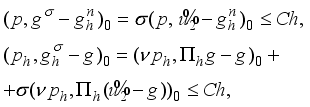 (20)
(20) 
 the different constants independent of
  .
. 
 . Taking into account the assumption 1, we get
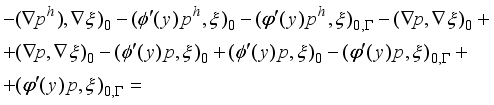
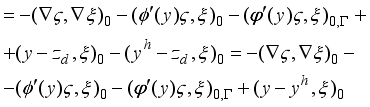
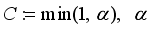 is positive seen in assumption 1.
 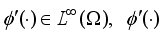 and 1) of lemma 2, we get
  (21)
(21)  .
.  .
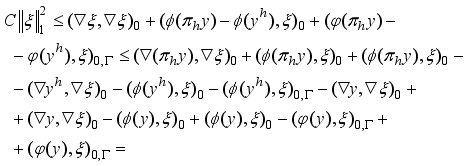
. 



 (22)
(22)  satisfy, it holds that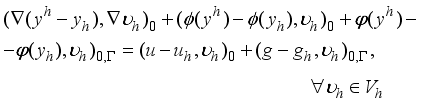
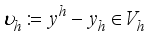 and consider the strong monotonicity of
  and monotonicity of
  , then we get
  (23)
(23)  satisfy, we get

 ,
,  and set a test function as
 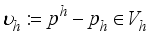 , we get the following expression
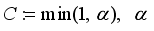 is positive seen in assumption 1.
 (24)
(24) 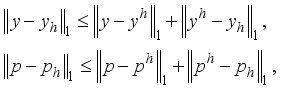 (25).
(25). 


 to satisfy
  . Then it holds that
  (26)
(26) 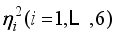 .
.  , it holds that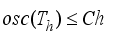
 all the constants independent of
  .)
.) 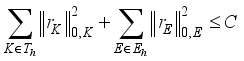 (
(  is independent of
  ). Here,
  are defined in lemma 5 to be
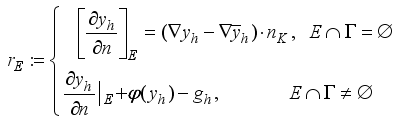
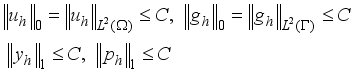 (27)
(27)  is a constant independent of
  .
.  and by assumption 1,

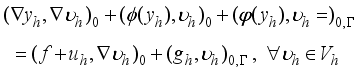
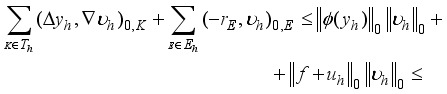
 .
.  as
as 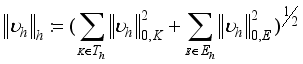
 In
In  , we think of a functional
  .
.  ,
,  is a bounded linear functional in
  and by Riesz’ representation theorem, there exists a unique element
  ,
,  such that
 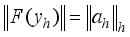 .
.  (28)
(28) 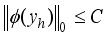 (
(  is independent of
  ), we get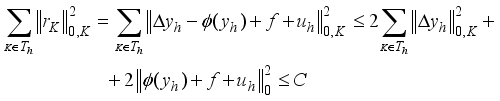
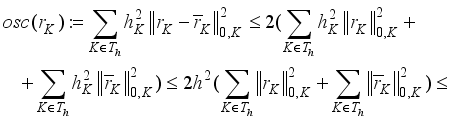
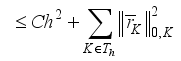
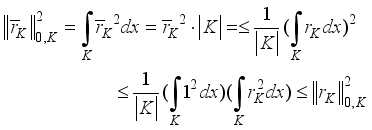

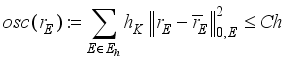
 .
. 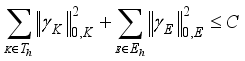 (
(  is a constant independent of
  ). Here,
  are defined in lemma 5 to be as follows.
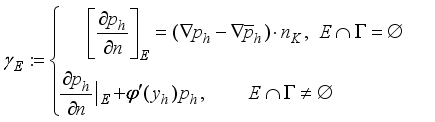

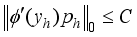

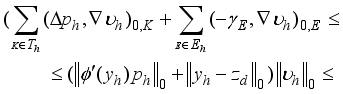
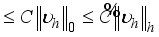 , (
, (  are independent of
  )
)  , introducing a functional

 such that
 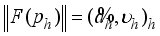 and
and 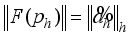 . Therefore, it holds that
  ,
, 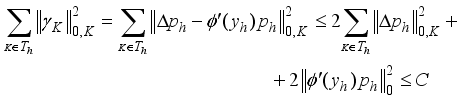

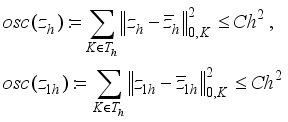
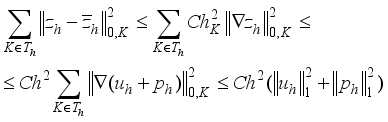 (29)
(29) 
 , we get.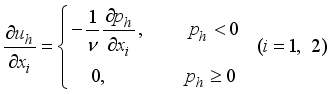

 .
.  .
. 

 be the solutions of (5) and (6), (7) respectively. When
  , the following convergence result about a posteriori error indicator holds.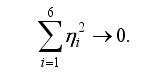
 . Using theorem 4 and lemma 8, the result follows from theorem 3.
 FEM | Finite Element Method |
| [1] | Wei Gong et al., Adaptive finite element method for parabolic equations with Dirac measure, Comput. Methods in Applied Mechanics and engineerig, 328(2018) 217-241. |
| [2] | Chunjia Bi et al., Two grid finite element method and it’s a posteriori error Estimates for a non-monotone quasi-linear elliptic problem under minimal regularity of data, Computers and Mathematics with Applications, 76(2018) 98-112. |
| [3] | Chuanjun Chen et al., A posteriori error Estimates of two grid finite volume element method for non-linear elliptic problem, Computers and Mathematics with Applications, 75(2018) 1756-1766. |
| [4] | Xingyang Ye, Chanju Xu, A Posteriori error estimates for the fractional optimal control problems, Journal of Inequalities and Applications, 141(2015), 1-13. |
| [5] | Lin Li et al., A posteriori error Estimates of spectral method for non-linear parabolic optimal control problem, Journal of inequalities and applications, 138(2018) 1-23. |
| [6] | E. Casas et al., Error Estimates for the numerical approximation of Dirichlet boundary control for semilinear elliptic equations, SIAM J. Control Optim., 45(2006) 1586-1611. |
| [7] | D. Y. Shi, H. J. Yang, Superconvergence analysis of finite element method for time-fractional thermistor problem, Appl. Math. Comput., 323 (2018) 31-42. |
| [8] | D. Y. Shi, H. J. Yang, Superconvergence analysis of nonconforming FEM fornonlinear time-dependent thermistor problem, Appl. Math. and Compu., 347 (2019) 210-224. |
| [9] | Y. Chen, L. Chen, X. Zhang, Two-grid method for nonlinear parabolic equations by expande mixed finite element methods, Numer. Methods Part. Diff. Equ., 29(2013) 1238-1256. |
| [10] | Meyer C., Error estimates for the finite element approximation of an elliptic control problem with pointwise state and control constraints, Control and Cybern., 37(1), 51-83 (2008). |
| [11] | Wollner W., A posteriori error estimates for a finite element distretization of Interior point methods for an elliptic optimization problem with state constraints, Numer. Math. Vol. 120, No. 4, 133-159 (2012). |
| [12] | A. Rosch, D. Wachsmuth, A posteriori error estimates for optimal control problems with state and control constraints, Numerische Mathematik, Vol. 120, No. 4, 733-762 (2012). |
| [13] | O. Benedix, B. Vexler, A posteriori error estimation and adaptivity for elliptic optimal control problems with state constraints, Comput. Optim. Appl., 44(1), 3-25 (2009). |
| [14] | Dib S., Girault V., Hecht F. and Sayah T., A posteriori error estimates for Darcy’s problem coupled with the heat equation, ESAIM Mathematical Modelling and Numerical Analysis, |
| [15] | A. Allenes, E. Otarola, R. Rankin. A posteriori error estimation for a PDE constrained optimization problem involving the generalized Oceen equations, SIAM J. Sci. Comput., Vol. 40, No. 4, A2200-A2233, 2018. |
| [16] | Natalia Kopteva. Error analysis of the L1 method on graded and uniform meshes for a fractional-derivative problem in two and three dimensions. Math. Comp., 88(319): 2135-2155, 2019. |
| [17] | Xiangcheng Zheng and Hong Wang. Optimal-order error estimates finit element approximations to variable-order time-fractional diffusion equations without regularity assumptions of the true solutions. IMA J. Numer. Anal., 41(2): 1522-1545, 2021. |
| [18] | Natalia Kopteva. Pointwise-in-time a posteriori error control for time-fractional parabolic equations. Appl. Math. Lett., 123: Paper No. 107515, 8, 2022. |
APA Style
Kim, C. I., Kang, J. H., Sok, G. C. (2025). A Posteriori Error Estimates and Convergence of Error Indicator by FEM for a Semi-linear Elliptic Source-boundary Control Problem. Mathematics Letters, 11(2), 41-59. https://doi.org/10.11648/j.ml.20251102.12
ACS Style
Kim, C. I.; Kang, J. H.; Sok, G. C. A Posteriori Error Estimates and Convergence of Error Indicator by FEM for a Semi-linear Elliptic Source-boundary Control Problem. Math. Lett. 2025, 11(2), 41-59. doi: 10.11648/j.ml.20251102.12
AMA Style
Kim CI, Kang JH, Sok GC. A Posteriori Error Estimates and Convergence of Error Indicator by FEM for a Semi-linear Elliptic Source-boundary Control Problem. Math Lett. 2025;11(2):41-59. doi: 10.11648/j.ml.20251102.12
@article{10.11648/j.ml.20251102.12,
  author = {Chang Il Kim and Jong Hyok Kang and Gi Chol Sok},
  title = {A Posteriori Error Estimates and Convergence of Error Indicator by FEM for a Semi-linear Elliptic Source-boundary Control Problem
},
  journal = {Mathematics Letters},
  volume = {11},
  number = {2},
  pages = {41-59},
  doi = {10.11648/j.ml.20251102.12},
  url = {https://doi.org/10.11648/j.ml.20251102.12},
  eprint = {https://article.sciencepublishinggroup.com/pdf/10.11648.j.ml.20251102.12},
  abstract = {In this paper, we obtain convergence of a posteriori error indicator to 0 when the mesh size h goes to 0 for the finite element approximation of source-boundary control problems governed by a system of semi-linear elliptic equations. We give the upper and lower bound of a posteriori error, and convergency of a posteriori error indicator.
},
 year = {2025}
}
TY  - JOUR
T1  - A Posteriori Error Estimates and Convergence of Error Indicator by FEM for a Semi-linear Elliptic Source-boundary Control Problem

AU  - Chang Il Kim
AU  - Jong Hyok Kang
AU  - Gi Chol Sok
Y1  - 2025/09/03
PY  - 2025
N1  - https://doi.org/10.11648/j.ml.20251102.12
DO  - 10.11648/j.ml.20251102.12
T2  - Mathematics Letters
JF  - Mathematics Letters
JO  - Mathematics Letters
SP  - 41
EP  - 59
PB  - Science Publishing Group
SN  - 2575-5056
UR  - https://doi.org/10.11648/j.ml.20251102.12
AB  - In this paper, we obtain convergence of a posteriori error indicator to 0 when the mesh size h goes to 0 for the finite element approximation of source-boundary control problems governed by a system of semi-linear elliptic equations. We give the upper and lower bound of a posteriori error, and convergency of a posteriori error indicator.

VL  - 11
IS  - 2
ER  -
Department of Mathematics, University of Science, Pyongyang, DPR Korea
Department of Mathematics, University of Science, Pyongyang, DPR Korea
Department of Mathematics, University of Science, Pyongyang, DPR Korea



 Share This Article
 Twitter
 Linked In
 Facebook
 of (
of (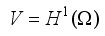 .
.  are unique solutions of (
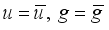 .
.  denote Gateaux differential of the solution of (
 at
at  in the direction of
  ,
,  in the first equation of (
 in the adjoint system, and comparing them, we get
  of (
of ( .
. 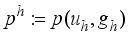 is a function defined in (
 is a constant independent of
  and
and  .
.  be the solutions of (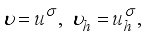
 is a constant independent of
  .
.  Copy
Copy Download